

Get to Know Your Ev

Charging Basics
Charging your electric vehicle (EV) is simple! Know the of chargers: Level 1 (standard outlets), Level 2 (home), and DC Fast Chargers (quick-ups).
Understand charging times to plan your trips around stations With this knowledge, you're ready to drive with confidence!

How to use public charging:
Park so the cable reaches your charge port.
Open the charge port on the vehicle.
Plug in the connector.
Start the session using the screen, app, credit card reader, or station QR code.
When finished, stop the session and unplug. Return the connector to the holster.
Public Charging: Apps, Cards, and Payment
Most stations let you start a session by:
-
Tapping a credit or debit card if the unit has a reader
-
Using a network app such as ChargePoint, Flo, EVgo, or EVolution
-
Scanning the station QR code for a web start
-
At a Tesla Supercharger station with a Tesla vehicle, simply plug in
Tip:
-
Add your card to the app before you arrive
-
Keep a backup method in case cell service is weak
-
Watch the screen for connector selection and pricing
Troubleshooting at a Charger
-
If a session will not start:
-
Re-seat the connector firmly.
-
Try the second handle if the unit has more than one.
-
End the session in the app, then start again.
-
Move to the next stall or the next site in your map.
-
Report the issue in the app so the site host can fix it.
If charging is very slow:
-
Make sure you did not select a Level 2 stall by mistake
-
The battery may be cold or hot. The car will limit its speed until conditions improve
-
High usage periods can mean having to share power across stalls
Utility programs:

_edited_edited.png)
_edited_edited_edited_.png)
-
Off-peak EV rates lower charging costs at night.
-
Possible charger rebates or utility make-ready programs.
Charging cost versus gas:
-
Off-peak home charging often costs the equivalent of paying about one to two dollars per gallon, or less. This depends on the utility rates in your area.
-
Public Level 2 might be free or low-cost at community sites.
-
DC fast charging costs more but is mainly used for longer trips, quick top-ups, and where home charging isn’t available.
This Atlas Policy study shows a detailed analysis of how EVs cost the same or less than many new cars on the market.


Weather
Performance
EVs perform well across a range of weather conditions.
EVs perform well across a range of weather conditions.
Winter:
-
EVs feel stable on snow and ice due to the low, centered battery.
-
Motors respond with “instant torque to wheels, allowing for traction control to be precise.
-
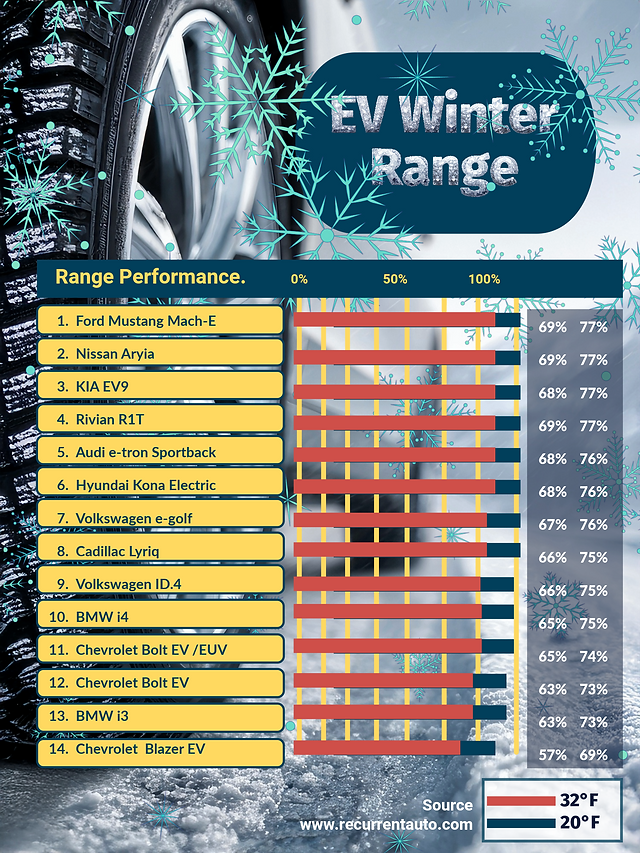
The range can drop 10 to 40 percent in deep cold because battery heating and cabin heat use energy. Purchasing a new EV with a heat pump can help mitigate this drop significantly
Tips:
-
Preheat the vehicle while plugged in
-
Use heated seats and a steering wheel
-
Keep tires inflated to the recommended levels
-
If available, store in a garage when cold out to keep the battery warmer
Rain:
-
Drive and charge normally.
-
Charge ports are sealed and outdoor-rated.
Extreme heat:
-
AC uses energy, so the range may drop 5 to 15 percent.
-
Fast charging may slow temporarily to protect the battery.
Battery lifespan and warranty:
-
New EV batteries are covered by a Federally required 8-year or 100,000-mile warranty. Some manufacturers may have more generous terms, and some states may have stronger requirements
-
Many last significantly longer. Capacity decline is gradual.
-
Replacement on newer EVs is rare, and costs continue to fall. Many packs are modular, so individual modules can be replaced.
Battery safety:
-
EV fires are rare compared with gas vehicle fires.
-
EVs monitor temperature and protect the battery by adjusting power or charging rate.
Performance, Weather, and Battery Health

EV Capability: Road Trips, Towing, Backup Power
Long-distance travel
-
Enter your destination into the car's navigation system. It selects fast chargers and prepares the battery for faster charging.
-
Apps like PlugShare or Google Maps let you preview routes and charger locations.
Towing and payload
Electric trucks and SUVs are excellent for towing thanks to instant torque and regenerative braking, which help control downhill loads.
The weight of a trailer reduces range by 30% to 50%, depending on size, speed, and terrain. Most modern EVs include a “towing mode” or “trailer profile” to optimize performance and adjust range estimates while towing.
Tips for towing with an EV
-
Pre-plan your route: Use PlugShare, A Better Routeplanner, or in-car navigation to find chargers that allow trailer access.
-
Check weight limits: Follow your vehicle’s Gross Combined Weight Rating (GCWR) and tongue weight specs.
-
Use regenerative braking smartly: It improves stability and captures some energy when slowing.
-
Watch for aerodynamic drag: Boxy trailers or headwinds affect range more than weight alone.
-
Charging with a trailer: Some stations require you to unhook or park sideways. Choose sites with pull-through access where possible.
-
Cold weather towing: Energy use increases in cold conditions; keep battery preconditioned before charging for faster results.